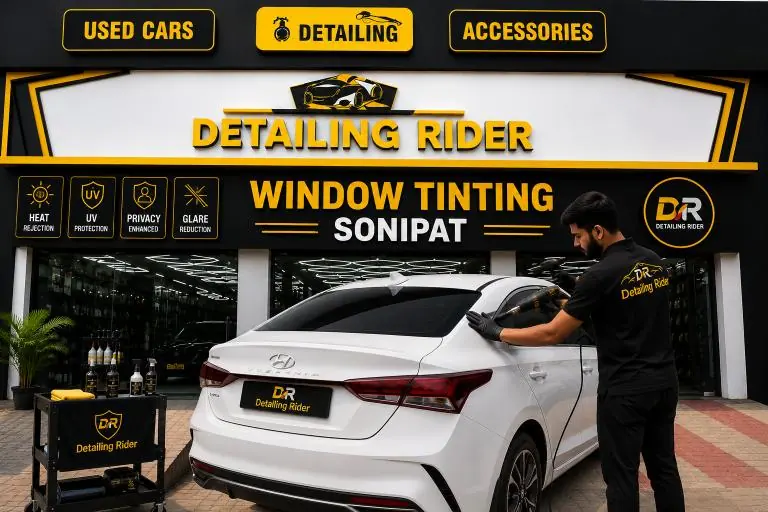
Car window tinting in Sonipat, kept within the law
Sun control film that takes the sting out of a Haryana summer without breaking CMVR rules. We fit it by hand at our Sonipat studio and only in shades you can legally drive with.
Why Sonipat cars get so hot inside
Leave a car in an open lot in Sonipat on a June afternoon and you know the result. The steering wheel is too hot to hold and the AC needs ten minutes to catch up.
Most of that heat comes in through the glass. The infrared part of sunlight is what you feel on your arm and face, and on a daily NH-44 run to Delhi the sun sits on one side of you most of the way.
Window film is a thin polyester layer fitted to the inside of the glass. A good one filters most of the UV and a fair share of the infrared, and it does not need to be dark to do that.
We never fit black or dark films. Every shade stays inside the CMVR Rule 100 limits.
What the law says about sun film in India
Under CMVR Rule 100, the windscreen and rear glass must let through at least 70 percent of visible light, and the side windows at least 50 percent. This is called VLT, visible light transmission.
Factory glass is not perfectly clear to begin with, so the film and glass together have to meet the limit. On a windscreen that means a film that looks almost clear. Side windows have a little more room, but nothing like the black look you see on some highway cars.
Dark films are not allowed, and police can stop the car, issue a challan and even peel the film off. Some officers question any visible film at all, so we keep shades on the safe side and tell you the VLT of what we fit.
Dyed, carbon and ceramic film side by side
All three can be fitted in legal shades, but they behave very differently in the heat.
| Film type | How it handles heat | Look and life | Good for |
|---|---|---|---|
| Dyed film | Absorbs heat in the dye, so the glass gets warm. Modest heat reduction. | Can fade towards purple and bubble after a few summers. | Budget jobs and cars that mostly sit in shade |
| Carbon film | Carbon particles block a fair part of the infrared. Clearly cooler than dyed. | Matte, non-reflective finish that holds its colour well. | Daily city and highway use |
| Ceramic film | Ceramic particles reject the most infrared, even in a light shade. | Stays clear and does not fade. | Cars parked in the open sun and long highway drives |
Heat rejection is about infrared, not darkness
People often assume a darker film is a cooler film. That was true of old dyed films, but it is not how carbon and ceramic films work. They target the infrared band, which you cannot see, so a light ceramic film can keep out more heat than a dark dyed one.
When you compare films, ask for the infrared rejection figure, not just the shade. We hold samples against your own glass in daylight before we start.
What a good film does for you day to day
Heat is the main reason people come in, but it is not the only benefit.
UV protection
Most quality films block nearly all UV, which protects your skin on long drives and slows the fading of the dashboard and seats.
Less glare
Low evening sun on the highway is easier on the eyes, especially through the side windows.
Clear night vision
Because we stay within legal shades, you still see the road, cyclists and unlit tractors clearly after dark and in winter fog.
No signal trouble
Carbon and ceramic films contain no metal, so phone calls, GPS and FASTag readers work as normal.
How we fit window film at the Sonipat studio
Most cars are done in a few hours, and you can wait or drop the car and come back.
Check the glass and agree the shade
We look for chips and old glue, then confirm the film and shade for each window.
Deep clean
Glass and rubber seals are cleaned so no dust gets trapped under the edge.
Cut and shape
Film is cut to the window. On curved rear glass it is shrunk with a heat gun on the outside so it sits flat later.
Apply and squeegee
The film goes on the inside with a slip solution, then water is pushed out from the centre towards the edges.
Seal and inspect
Edges are pressed down and every window is checked in good light for dust spots and gaps.
Curing time and the first week
Fresh film still has a little water behind it, and it needs time to dry and bond. Please do not roll the windows down for 3 to 5 days. In cold, foggy weather give it closer to a week, or the bottom edge can lift.
A slight haze or small water pockets in the first few days are normal and clear as the film cures. A bubble with dust inside that is still there after two weeks is not, so bring the car back and we will check it.
Looking after tinted windows
Clean the inside of the glass with a soft microfibre cloth and water or an ammonia-free cleaner, since ammonia can cloud the film. No blades or scrub pads.
Watch seatbelt buckles and rings near the side glass, as a sharp edge can nick the film. The rear defogger works normally through it.
Work that pairs well with window film
Many owners book tint with ceramic coating for the paint or a full interior detail, since the car is already with us. If you drive NH-44 every day, paint protection film on the front stops stone chips that no coating can.
Film prices depend on the type and car size, so see the price list. Pickup can be arranged on request.
Questions people ask
Is window tinting legal in India?
Film is allowed only if the glass keeps at least 70 percent visible light on the windscreen and rear glass and 50 percent on the side windows, as set by CMVR Rule 100. Dark and black films are not legal anywhere in the country.
Which film keeps the car coolest in a legal shade?
Ceramic film, because it rejects infrared with ceramic particles rather than dark dye. Carbon film sits in the middle.
How long does it take to fit film on a whole car?
A few hours for most hatchbacks and sedans, a bit longer for SUVs with large rear glass. Same-day delivery is normal.
When can I roll my windows down?
Wait 3 to 5 days, and closer to a week in cold or foggy weather. This lets the adhesive bond fully so the bottom edge does not lift when the glass slides into the door.
Will film affect my FASTag or phone signal?
Carbon and ceramic films contain no metal and do not interfere with FASTag, GPS or mobile signals. Some older metallised films can, so we do not use them.
Can you remove old dark film from my car?
Yes. We peel the old film, remove the leftover glue and clean the glass before fitting a legal shade.
Where the work is done
Sonipat head office
Sai Baba Road, near Devendra Photostat, opp. MRF Tyres, Saipuram, Bhagat Pura, Sonipat, Haryana 131001
+91 70561 03055
+91 70561 66055
Monday to Saturday, 9 AM to 7 PM. Sunday closed.
Want an exact price for your car?
Send the car model and a couple of photos on WhatsApp. We reply with the right option and the price, usually the same day.