The question we hear every week
Almost every new car owner who walks into our studio asks some version of the same thing. Should I get PPF or ceramic coating? Which one is better? Is one a cheaper version of the other?
The short answer is that they are not competing products. They protect against different things, they feel different to live with, and they cost very differently. Once you see what each one actually does, the choice usually becomes obvious for your car and the way you drive it.
What paint protection film actually is
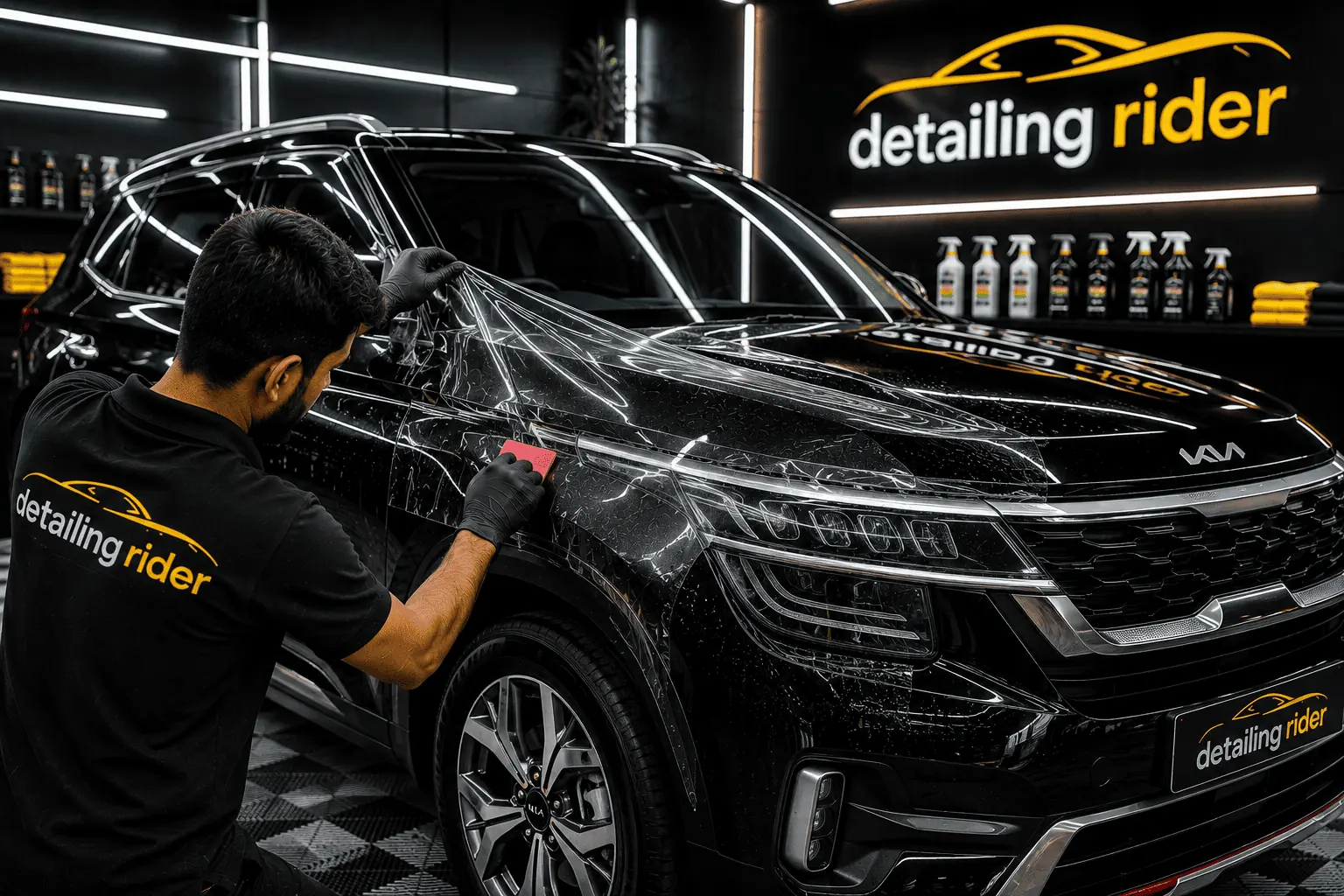
PPF is a clear polyurethane film, thicker than you might expect, that is cut to the shape of each panel and laid onto the paint with a slip solution. Once it settles, it is almost invisible.
Its job is physical protection. When a stone flicks up from a truck on NH-44, the film takes the hit and the paint underneath stays intact. Light scratches in the top layer heal when the film warms up in the sun or under warm water. It also resists bird droppings and tree sap better than bare paint.
Good PPF comes with a written warranty, up to 5 years depending on the film. You can have it as gloss or matte, and colour change PPF changes the look of the car while protecting it.
What ceramic coating actually is
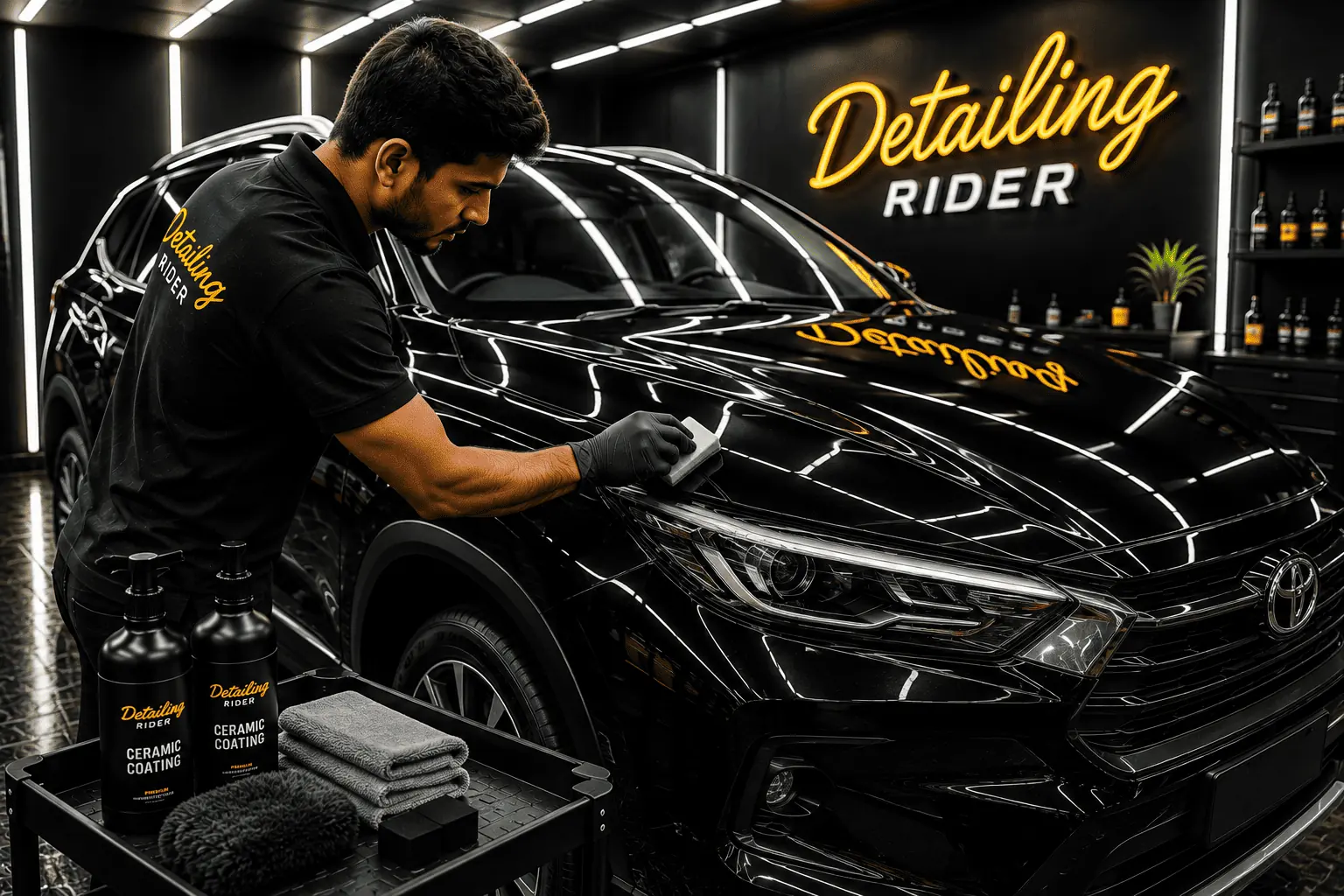
A ceramic coating is a liquid that is wiped onto the paint, levelled by hand and left to cure into a very thin, hard, glassy layer bonded to the clear coat. It is far thinner than film.
Its job is chemical and cosmetic. Water beads and runs off, dust has a hard time sticking, bird droppings are less likely to etch, and the colour looks deeper and wetter. The car becomes much easier to wash. What it will not do is stop a stone chip. It is simply too thin.
We offer 7H, 8H, 9H and 9H+ grades, lasting from 1 to 5 years depending on the grade and how the car is washed.
Side by side
This is the comparison we sketch on paper for customers.
| PPF | Ceramic coating | |
|---|---|---|
| Stone chips | Stops most of them | No real protection |
| Fine wash scratches | Self-heals light marks | Resists them, does not heal |
| Gloss and colour depth | Good, gloss or matte | Very high, wet look |
| Easy washing | Moderate | Very easy, water sheds off |
| Bird droppings and sap | Good resistance | Good resistance |
| Life | Up to 5 years depending on film | 1 to 5 years depending on grade |
| Time at the studio | 1 to 3 days | 1 to 2 days for most grades |
| Relative cost | Higher | Lower |
When PPF is the right choice
Pick PPF if chips are your main worry. That means regular highway driving on NH-44, the KMP Expressway or the roads towards Panipat and Rohtak, where loaded trucks throw gravel at bonnet height. It also means narrow lanes with hedges, tight society parking where doors and bumpers get brushed, and new premium cars where a single chip on the bonnet would bother you.
Most people do not need the whole car wrapped. Full front PPF, covering the bonnet, bumper, fenders, mirrors and headlamps, protects the panels that actually get hit. Door edge guards are a small add-on that saves a lot of touch-up work. Full body PPF makes sense for dark colours, high-value cars and owners who want the paint to stay original for resale.
When ceramic coating is the right choice
Pick a ceramic coating if your problem is daily dirt rather than impacts. Cars parked under trees, in open lots, near construction sites or in dusty industrial areas get dirty fast. A coated car comes clean with a rinse and a gentle wash, so you stop scrubbing and stop adding swirl marks.
Coating also suits city cars that rarely see the highway, older cars that have just had their paint corrected, and owners who simply love a deep gloss. Since it costs less than film, it is the sensible first step for many budgets.
When combining the two makes sense
This is the setup we fit most often on new cars that are driven a lot: full front PPF where the chips land, and a ceramic coating over the rest of the body and on top of the film. The front gets impact protection, the whole car gets the easy washing and gloss, and the film itself stays cleaner because it is coated too.
Combining also smooths the look. Coating over film and over paint gives the whole car the same water behaviour and shine, so you cannot tell where the film ends.
Whatever you choose, the paint underneath has to be corrected first. Film and coating both lock in whatever is there, swirls and all.
How the cost logic works
PPF costs more because of material and labour. Film is expensive per square foot, and fitting it takes hours of cutting, stretching and tucking edges around every curve. The price grows with coverage, from partial front to full front to full body.
Ceramic coating costs less because the material per car is small. Most of the price is preparation, the wash, decontamination and polishing that happen before the bottle is opened. Higher grades cost more because they last longer and need more careful layering.
A useful way to think about it is cost per year. Divide the price by the years you will keep the car or the protection. A higher coating grade on a car you will keep for five years often works out cheaper per year than redoing a basic one. You can see current package rates on our price list.
Quick ways to decide
If you are still unsure, these rules of thumb usually settle it.
Lots of highway driving
Start with full front PPF. Add coating when the budget allows.
Mostly city, parked outside
A mid or higher grade ceramic coating is usually enough.
New premium or dark car
Full front or full body PPF, with coating on top.
Older car with tired paint
Paint correction first, then coating. Film can come later if needed.
Tight budget
Partial PPF on the bonnet edge and bumper, or a lower coating grade, done properly.